
NSW 2009, Australia
100 Harris St, Pyrmont
24/7 Customer Support
Mon - Fri: 8:00 - 18:00
You can contact us during the above work hours.
Construction Lawyer & Building Solicitors Sydney | Contracts Specialist Law Firm

Understanding your rights and review options when NSW Fair Trading refuses or cancels your contractor licence.
You can be confident that you are getting the right legal advice.
If your contractor licence has been refused or cancelled by the NSW Office of Fair Trading, you have specific legal rights and review processes available under the Home Building Act 1989 (NSW). This guide explains the grounds for refusal or cancellation, the internal and external review processes, critical timeframes, and the practical steps you must take to protect your business and licensing rights.
BOOK YOUR FIRST FREE CONSULTThe NSW Office of Fair Trading has the statutory authority to refuse an application for a contractor licence or cancel an existing licence under the Home Building Act 1989 (NSW). The primary grounds for refusal or cancellation include:
These grounds are designed to protect consumers and maintain professional standards within the NSW building industry. Understanding the reasons for licence refusal or cancellation is essential before applying for administrative review or seeking legal advice. If Fair Trading has refused or cancelled your licence on any of these grounds, you must understand the decision basis before pursuing review options.
Under NSW administrative law principles, Fair Trading is required to provide reasons for decisions that affect your legal rights and business interests. If the decision refusing or cancelling your contractor licence does not include specific reasons, you have the right to request a written statement of reasons. Fair Trading is required to provide these reasons within 28 days from the date of receipt of your written request. Obtaining clear reasons is an essential first step before pursuing internal or external review, as it allows you to understand the factual basis and legal grounds for the decision and prepare an effective response.
A properly reasoned decision from Fair Trading refusing or cancelling a contractor licence must contain the following essential elements:
These requirements ensure transparency and accountability in administrative decision-making. A properly reasoned decision allows you to identify potential errors in fact-finding, legal interpretation, or reasoning that may form the basis of a successful internal or external review application.
When Fair Trading refuses or cancels a contractor licence, you have specific administrative review rights protected under NSW legislation including the Fair Trading Act 1987 and the Administrative Decisions Review Act 1997. These review rights ensure procedural fairness and natural justice principles are applied to licensing decisions that significantly impact your business operations and professional reputation.
Administrative review allows you to challenge both the factual findings and legal reasoning used by Fair Trading. This includes reviewing whether Fair Trading properly considered all relevant evidence, correctly interpreted the Home Building Act 1989 requirements, and exercised its discretionary powers reasonably and without bias. Understanding these review rights is essential before the 28-day statutory timeframe expires, as missing deadlines can permanently remove your ability to challenge an incorrect or unjust licensing decision.
Your first avenue for addressing a refusal or cancellation decision is to request an internal review by Fair Trading. This is a statutory review process that allows Fair Trading to reconsider its original decision.
An application for internal review must be lodged within 28 days from one of the following dates:
It is critical for any request for an internal review to be lodged within these statutory timeframes. Failure to lodge within time may result in your application being rejected as out of time.
If you have run out of time to request an internal review, you have two options:
Your application for internal review must comply with specific formal requirements under NSW administrative law. The application must be:
Beyond these formal requirements, your application should contain all relevant documents and information that support your case. This includes evidence, submissions, and explanations that demonstrate why the licence should not have been refused or cancelled. You should address the specific grounds relied upon by Fair Trading in its original decision and provide factual and legal arguments as to why those grounds are not made out or do not justify refusal or cancellation.
A well-prepared internal review application can result in Fair Trading reconsidering and reversing its original decision without the need for external tribunal review.
After you have lodged a compliant internal review application, Fair Trading is required to conduct a fresh review of the original decision. The internal review is conducted by a different decision-maker within Fair Trading who was not involved in the original decision. This ensures a degree of independence and objectivity in the review process.
Fair Trading has 21 days from the date of receipt of your internal review application to complete the review and provide its determination. This statutory timeframe ensures that review decisions are made promptly and do not unduly delay your ability to pursue further review options if necessary. If Fair Trading fails to make a decision within 21 days, you may have grounds to apply directly to NCAT for external review on the basis of deemed refusal.
Following internal review, Fair Trading has three possible decision outcomes:
Fair Trading must provide you with written notice of its internal review decision, including reasons for that decision. If the internal review decision is unfavourable, you have the right to pursue external review.
Internal review applications are most successful when they demonstrate specific errors in Fair Trading's original decision-making process. Understanding these common grounds helps structure your application effectively and increases the likelihood of Fair Trading reconsidering its position.
Fair Trading failed to provide adequate opportunity to respond to adverse information or allegations before making the licensing decision, breaching natural justice requirements under administrative law principles.
The original decision was based on incorrect or incomplete factual findings, such as miscounting complaint numbers, misunderstanding insurance coverage status, or failing to consider evidence of NCAT compliance.
Fair Trading misapplied Home Building Act 1989 provisions or applied incorrect legal tests when assessing grounds for refusal or cancellation.
New evidence or changed circumstances since the original decision address Fair Trading's concerns, such as appointment of nominated supervisor, obtaining required insurance, or resolving outstanding NCAT orders.
If you are dissatisfied with the outcome of Fair Trading's internal review decision, you have the right to apply for an external review to the NSW Civil and Administrative Tribunal (NCAT). NCAT is an independent statutory tribunal that has the power to conduct a merits review of Fair Trading's decision.
An external review by NCAT allows you to present evidence, make legal submissions, and have your case heard by an independent tribunal member. NCAT has the power to affirm, vary, or set aside Fair Trading's decision and substitute its own decision.
NCAT can review all aspects of Fair Trading's decision including factual findings, legal interpretation, and exercise of discretion. The tribunal operates under the Administrative Decisions Review Act 1997 NSW, providing comprehensive administrative review jurisdiction.
An application for external review to NCAT can be made in the following circumstances:
In most cases, it is advisable to exhaust the internal review process before applying to NCAT, as Fair Trading may overturn or vary its decision on internal review, avoiding the time and cost of tribunal proceedings. However, NCAT applications may be strategically preferable when immediate licence restoration is critical for business continuity or when independent tribunal assessment offers stronger prospects than internal departmental review.
If your contractor licence has been suspended (as distinct from cancelled or refused), you should consider applying to NCAT to lift the suspension. Under section 53(11) of the Administrative Decisions Review Act 1997 and clause 5 of the Administrative Decisions Review Regulation 2019, a decision referred to in section 79A(8) of the Fair Trading Act 1987 is excluded from the option of internal review. This means suspension decisions may be subject to different review pathways, and immediate external review to NCAT may be appropriate. You should seek specialist construction law advice if your licence has been suspended to determine the correct review pathway and urgency of response. Suspension decisions under section 79A of the Fair Trading Act 1987 require immediate NCAT application rather than internal review, with urgent hearing provisions available for cases where suspension threatens irreparable business harm or ongoing contractual obligations.
The following diagrams illustrate the different procedural pathways depending on whether Fair Trading's decision includes reasons, and the steps available if timeframes have lapsed.
Pathway A: If the decision cancelling or refusing the licence contains the reason:

Pathway B: If the decision cancelling or refusing the licence does not contain the reason:

Pathway C: If the decision cancelling or refusing the licence does not contain the reason AND you don't file a request for reasons:

Pathway D: In case 28 days has lapsed:
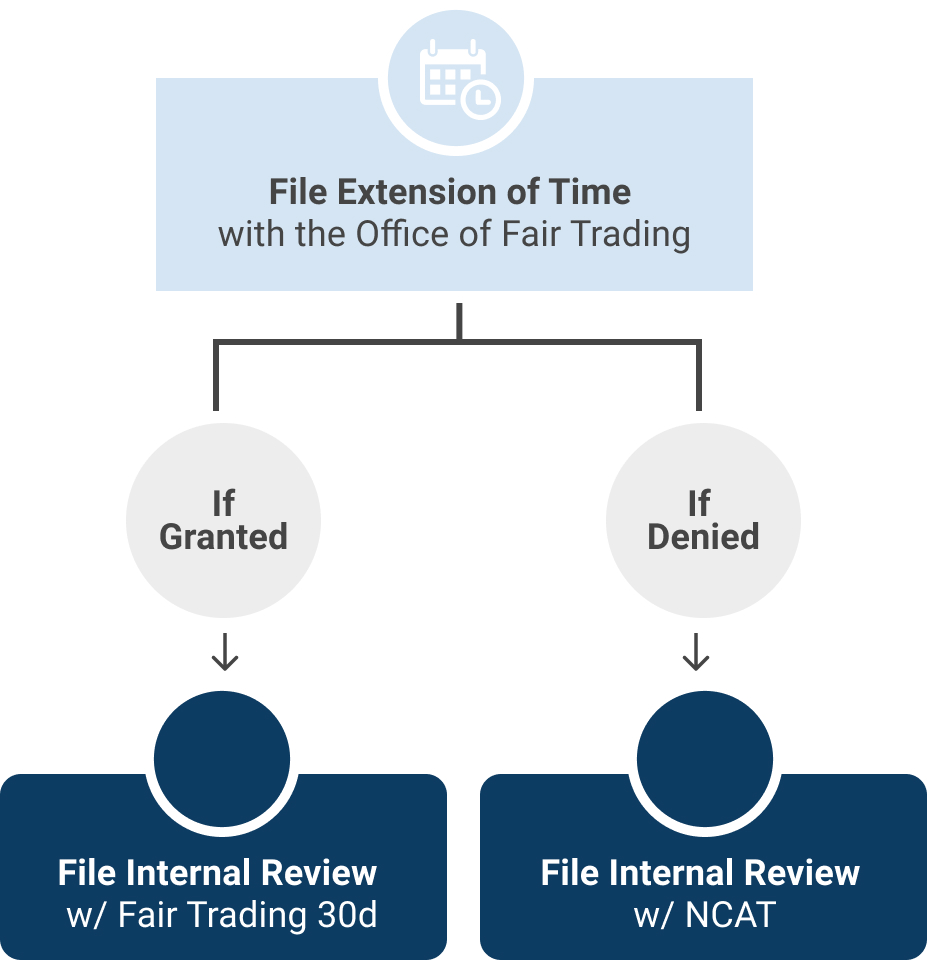
These workflows demonstrate the critical importance of understanding statutory timeframes and following the correct procedural steps. Missing deadlines or failing to lodge applications in the correct form can result in losing your review rights and being unable to challenge Fair Trading's decision.
The most common grounds include having too many complaints lodged against the company or its directors, failing to comply with NCAT orders within the required timeframe, not having a nominated supervisor for the company licence, and not complying with insurance requirements under the Home Building Act 1989 (NSW), particularly home warranty insurance obligations.
You have 28 days from the date you receive the decision (if no reasons are provided) or 28 days from the date you receive the written reasons (if you requested them). It is critical to lodge your internal review application within these timeframes, as late applications may be rejected unless Fair Trading grants an extension of time.
Your application must be in writing, addressed to Fair Trading, include a physical address in Australia for correspondence, and be lodged at the appropriate Fair Trading office. Beyond these formal requirements, you should include all relevant documents, evidence, and submissions that demonstrate why the licence should not have been refused or cancelled, directly addressing the grounds relied upon by Fair Trading.
You have the right to request a written statement of reasons. Fair Trading must provide these reasons within 28 days of receiving your written request. Obtaining clear reasons is essential before pursuing internal or external review, as it allows you to understand the factual and legal basis for the decision and prepare an effective response.
In most cases, you should exhaust the internal review process first. However, you may apply directly to NCAT for external review if Fair Trading has rejected your internal review application as out of time, or if it is necessary for NCAT to deal with the application to protect your interests and the application is made within a reasonable time of the original decision. Immediate external review may be appropriate in urgent circumstances.
Fair Trading can affirm the original decision (meaning the refusal or cancellation stands unchanged), amend the original decision (for example, imposing conditions rather than outright cancellation), or set aside the original decision and replace it with a new decision (such as granting or reinstating the licence). Fair Trading must provide written notice of its decision including reasons.
Licence suspension may be subject to different review pathways under section 53(11) of the Administrative Decisions Review Act 1997. Suspension decisions are excluded from internal review in certain circumstances, meaning immediate external review to NCAT may be appropriate. You should seek specialist construction law advice urgently to determine the correct review pathway and timeframe for response.
A refused or cancelled contractor licence can shut your business down overnight. The review window is just 28 days — and once it closes, your options become severely limited. John Dela Cruz has over 17 years of exclusive construction law experience representing contractors and builders in Fair Trading reviews and NCAT proceedings across NSW. He'll assess your grounds, advise on the correct review pathway, and give you a clear, practical plan of action — fast. Book your first free consultation today. No obligation, no charge for the initial call.
BOOK YOUR FIRST FREE CONSULT