
NSW 2009, Australia
100 Harris St, Pyrmont
24/7 Customer Support
Mon - Fri: 8:00 - 18:00
You can contact us during the above work hours.
Construction Lawyer & Building Solicitors Sydney | Contracts Specialist Law Firm

Expert guidance on the risks, requirements, and legal protections for homeowners entering HIA fixed price building contracts.
You can be confident that you are getting the right legal advice.
The HIA Fixed Price Building Contract is widely used across New South Wales for residential construction projects. Before signing, homeowners need to understand the contract's structure, hidden risks, and how terms like variations, provisional sums, and essential requirements can significantly impact your project cost and timeline. Learn what the contract means for your rights and obligations under NSW building law.
The Housing Industry Association (HIA) is Australia's national association for the residential building industry. The HIA creates standardised construction contract templates that members and the general public can use for commercial and residential building projects.
In New South Wales, the HIA fixed price building contract applies to both new residential construction and renovation projects. These contracts are specifically designed for fixed price arrangements where the total contract price is established before construction begins.
For residential builds in NSW, the HIA provides two primary fixed price contract templates:
Both contract types fall under the regulatory framework of the Home Building Act 1989 (NSW) and must comply with NSW consumer protection requirements for residential building work. Understanding the HIA fixed price contract structure and your legal obligations before signing protects homeowners from unfair builder terms and unexpected cost increases during construction.
Despite the name "fixed price," these contracts contain numerous provisions that can expose homeowners to significant financial risks and project delays. Understanding these risks before signing is essential for protecting your interests.
The NSW Government extended the Building and Construction Industry Security of Payment Act 1999 to cover residential building contracts. This law was originally designed for commercial construction and heavily favours builders in payment disputes.
Under SOPA, builders can make rapid payment claims against homeowners through an adjudication process. Homeowners unfamiliar with Security of Payment procedures face serious risks: builders can overclaim for incomplete or defective work, and the adjudication system provides very short timeframes (typically 10 business days) to respond with a payment schedule. Missing deadlines or failing to properly dispute claims can result in legally enforceable payment determinations - even if the builder's claim is excessive or unjustified. Early legal advice on SOPA payment claims and response requirements prevents enforcement action and protects homeowners from paying for disputed building work.
HIA fixed price contracts include "essential requirements" - specific obligations homeowners must satisfy within strict timeframes prescribed in the contract. Common essential requirements include:
If homeowners fail to satisfy any essential requirement within the time specified, the builder gains a contractual right to terminate the contract and claim payment for work completed plus additional costs. In effect, you pay the builder but gain little to no benefit from the terminated contract. A pre-signature contract review identifies unreasonable essential requirement timeframes and negotiates fair terms before you commit to the HIA building contract.
The HIA fixed price contract variation clauses are structured to favour builders and provide limited protection for homeowners. Builders who are skilled salespeople can easily persuade homeowners to approve variations during construction, and the contract terms make it difficult to challenge variation costs later.
Variation clauses typically allow builders to:
Understanding variation clause risks in HIA contracts before signing enables homeowners to negotiate builder margin limitations and approval timeframe protections.
One of the most significant risks homeowners overlook is how provisional sum and prime cost items operate in "fixed price" contracts. These allowances effectively convert portions of your fixed price contract into a cost-plus arrangement.
When the builder incurs costs exceeding the provisional sum or prime cost allowance, the contract permits the builder to claim the excess cost plus the builder's margin (typically 15-20%). This mechanism almost certainly exposes homeowners to contract price increases, sometimes amounting to tens of thousands of dollars beyond the signed contract price.
Homeowners often discover these cost blowouts too late in the construction process to negotiate or make alternative arrangements. Legal advice on provisional sum and prime cost item allowances helps homeowners assess whether the fixed price contract reflects realistic construction costs.
For most homeowners, the scheduled completion date is critically important for financial planning, rental arrangements, or sale of existing properties. However, HIA fixed price contracts make it remarkably easy for builders to extend the date for practical completion.
The contract provides builders with automatic time extensions for:
It's common for homeowners to experience completion dates extending 3-6 months or more beyond the original schedule. By the time homeowners realise the project is significantly delayed, they often face paying rent and mortgage interest simultaneously, creating substantial financial stress and limiting their accommodation options.
Understanding the distinction between these two HIA contract types helps homeowners choose the appropriate contract structure for their project and understand the risks inherent in each approach.
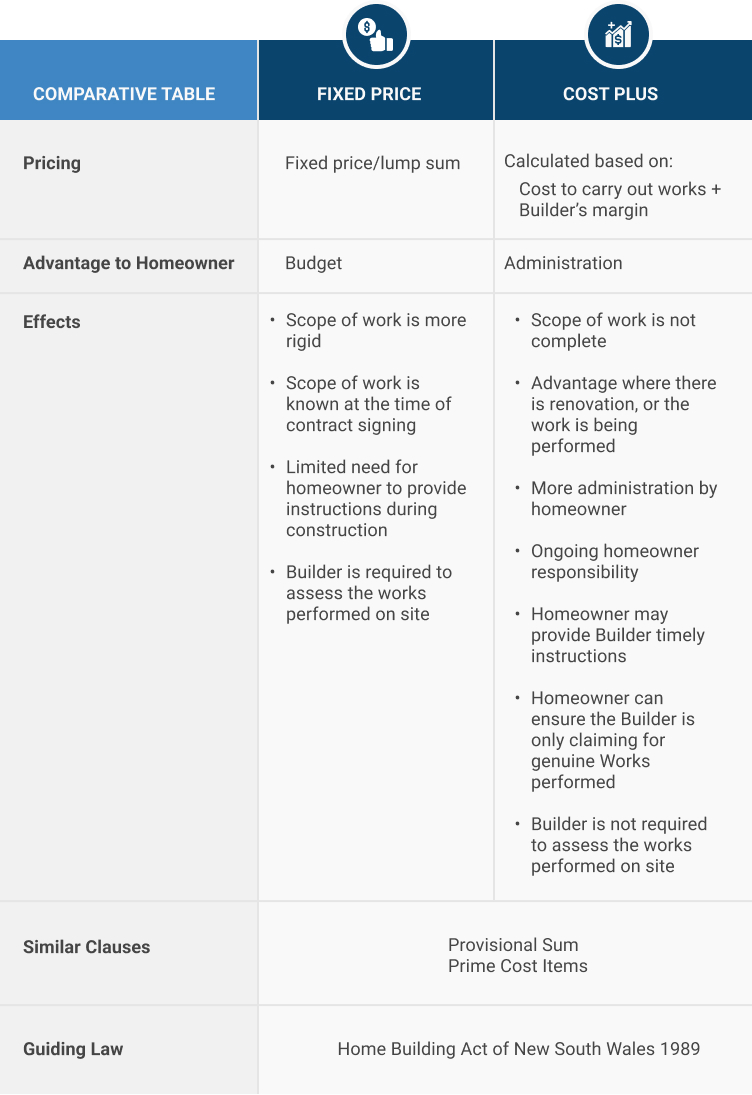
Comparison of fixed price and cost plus contract structures
The fixed price contract establishes a total contract sum at signing, which is supposed to represent the complete cost of the building work (subject to variations and adjustments for provisional sums and prime cost items).
The HIA cost plus contract calculates payment based on the actual cost incurred by the builder to carry out the works, plus an agreed builder's margin (typically a percentage of costs or fixed fee). The final contract price isn't known until construction is complete.
Both contract types are subject to the Home Building Act 1989 (NSW) and must comply with statutory warranties, insurance requirements, and consumer protection provisions. Choosing between HIA fixed price and cost plus contracts depends on project scope certainty, budget flexibility, and your capacity for ongoing contract administration during construction.
The fixed price (lump sum) contract has less flexibility because the scope of work must be clearly defined and documented before signing. Any changes to scope trigger the variation process with associated costs and time extensions.
The Cost plus contract provides advantages where renovation work is being performed and the full scope cannot be determined in advance. It allows for greater flexibility to make decisions during construction without the formal variation process. This makes cost plus more suitable for complex renovations where conditions can only be assessed once demolition or investigation work begins.
The cost plus contract imposes significantly more administration and ongoing homeowner responsibility compared to fixed price arrangements. Homeowners must:
With the fixed price contract, homeowner administration is less intensive because the builder assesses progress against the defined scope rather than claiming actual costs. The scope of work is established at signing, limiting the need for ongoing instructions during construction.
Importantly, HIA fixed price contracts contain elements that function like cost plus arrangements. Provisional sum and prime cost items have similar characteristics to cost plus provisions - the builder claims actual costs incurred (plus margin) when these allowances are exceeded.
This means homeowners signing "fixed price" contracts should understand they may actually be entering a hybrid arrangement with both fixed price and cost-plus components.
Building contracts can be amended through further agreement between the parties. For contract changes to be legally enforceable, the amendments should be documented by way of deed of amendment signed by both homeowner and builder.
A deed of amendment formally records the agreed changes to contract terms, price, scope, or timeframes. This ensures both parties have legal certainty about the modified contract obligations.
Important principle: Homeowners should not sign a building contract if there is any indication the contract terms will need to be changed after signing. Any necessary amendments should be negotiated and incorporated before you execute the contract.
If a builder suggests "we'll fix that up later" or "don't worry, we can change that after signing," this is a significant warning sign. All contract terms should be finalised and acceptable before you commit to the agreement. Construction lawyers review and negotiate deed of amendment terms to ensure contract changes reflect homeowner intentions and maintain legal protection under NSW building law.
In the post-COVID construction environment, builders in NSW have increasingly attempted to add terms to HIA template contracts that allow price increases beyond the agreed fixed price. The common purpose of these additional clauses is to shift cost risk to homeowners and enable builders to claim additional payments above the signed contract price.
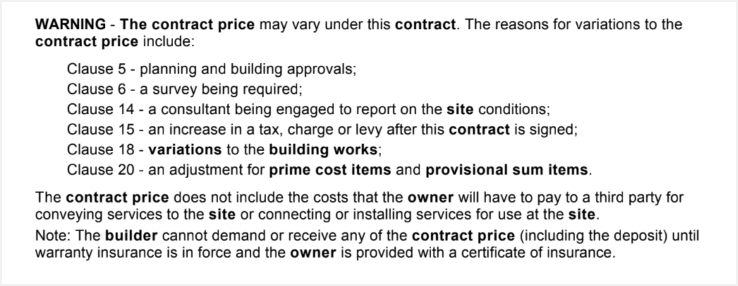
For illustration purposes only.
Builders may attempt to include:
Recognising the risk to homeowners, the NSW Government introduced specific requirements to the Home Building Act 1989 (NSW) and Home Building Regulation 2014. These regulations require builders to:
The warning must specifically alert homeowners that the "fixed price" may not actually be fixed if certain variation mechanisms apply. Despite these disclosure requirements, builders often include broad price increase provisions that expose homeowners to significant contract price variations beyond the signed amount.
Before signing any fixed price contract, homeowners should:
A specialist construction lawyer contract review identifies unfair rise and fall clauses, unrealistic provisional sums, and builder-favourable price variation terms before you sign the HIA fixed price building contract.
HIA fixed price building contracts frequently result in disputes between homeowners and builders despite their widespread use across NSW residential construction. Understanding common dispute scenarios helps homeowners recognise warning signs and seek early legal advice before problems escalate.
Payment Dispute Scenarios: Builders claiming payment under Security of Payment Act procedures for incomplete work, defective construction, or work not performed in accordance with contract specifications. Homeowners face rapid adjudication timeframes and risk enforcement action without proper legal response to payment claims.
Defects and Quality Disputes: Disagreements over whether completed work meets contract specifications, Australian Standards, or Home Building Act statutory warranty requirements. Builders often resist rectification obligations or claim defects result from homeowner-caused damage rather than construction defects.
Delay and Completion Disputes: Builders claiming extension of time entitlements while homeowners face financial pressure from extended rental periods and delayed project completion. Disputes over whether delay causes qualify for time extensions under contract terms and whether liquidated damages apply to builder-caused delays.

When you submit your building contract, it's reviewed personally by John Dela Cruz — Principal Lawyer at Contracts Specialist with over 17 years of exclusive construction law experience.
John is an Australian Legal Practitioner and he services NSW, Queensland, Victoria, and Tasmania. He has dedicated his entire legal career to specialise on construction law. As a former Divisional President of the Master Builders Association NSW, he combines deep legal expertise with comprehensive industry knowledge. He maintains daily experience in building dispute tribunals (NCAT, VCAT, QCAT) and courts across multiple jurisdictions.
Unlike generalist lawyers who handle various legal matters, John specialises exclusively in residential building contracts and homeowner protection. Your contract review focuses on identifying unfair terms, clarifying your legal obligations, and protecting you from costly mistakes before you sign.
Our streamlined contract review process is designed for homeowners who need expert legal analysis before signing their HIA fixed price building contract. No consultation required - just submit your contract and receive fixed-fee expert review. Specialist construction law contract review identifies unfair HIA contract terms, clarifies essential requirements, and explains your legal obligations under NSW building legislation before you commit to the building contract.
Upload your HIA fixed price building contract and provide basic details through our secure online form. Include any attachments, specifications, or plans that form part of the contract. No consultation required to get started.
Receive an immediate confirmation email acknowledging your submission. Reply to confirm you'd like to proceed with the fixed-fee review. This ensures we only prepare cost disclosures for homeowners ready to proceed.
Within 24 hours of your confirmation, receive a transparent cost disclosure via email setting out the fixed fee for your contract review. No obligation to proceed - review the cost disclosure and decide if you'd like expert analysis of your HIA contract.
Accept the cost disclosure and secure payment. Your detailed contract review identifying risks, unfair terms, and legal obligations will be delivered via email within 2 business days. The review provides clear guidance on contract provisions affecting your rights and financial exposure.
Don't sign your HIA fixed price building contract without understanding the risks, obligations, and financial exposure you're accepting. Our specialist contract review service identifies unfair terms, explains your legal position, and protects you from costly mistakes.
Why Homeowners Choose Our Contract Review Service:
Submit your HIA fixed price building contract now to receive your fixed-fee cost disclosure within 24 hours. No consultation required - just upload your contract, confirm your interest, and receive expert legal analysis before you sign.